
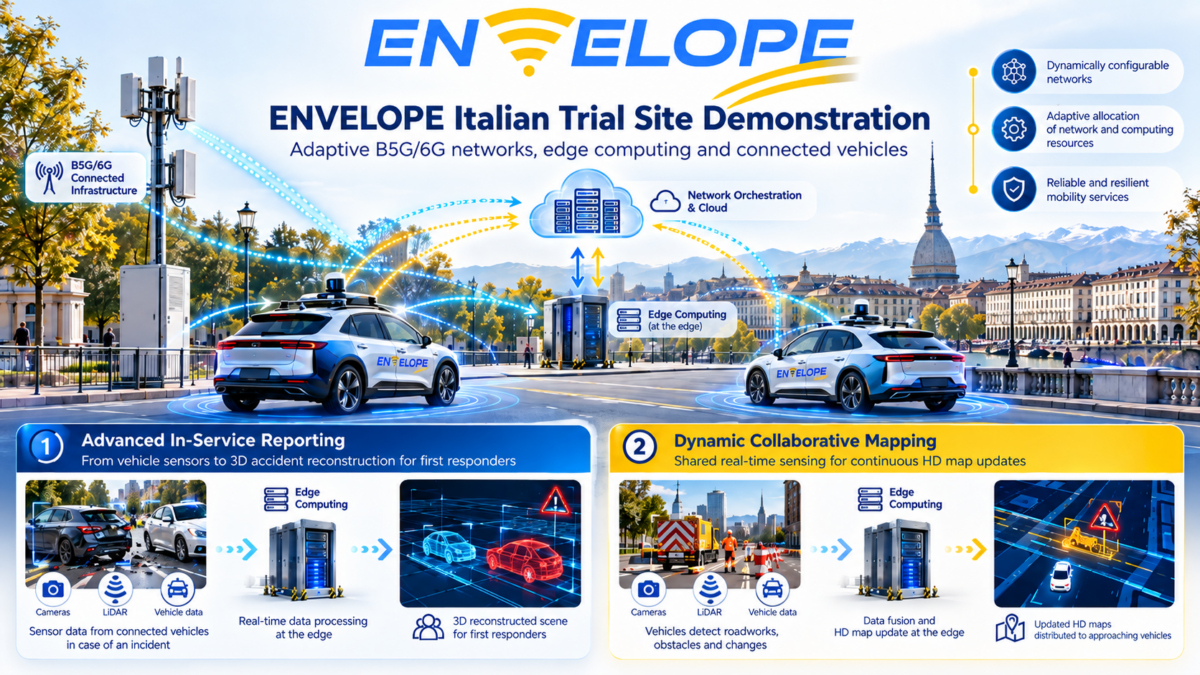
The Italian demonstration, held on 1 October 2026, showcased how dynamically configurable B5G/6G networks, edge computing and connected vehicles can work together to support more adaptive and reliable mobility services.
The ENVELOPE project brought its vision for Connected, Cooperative and Automated Mobility (CCAM) into a live demonstration environment at its Italian Trial Site on 1 October 2026. The event showcased how advanced network capabilities can support mobility applications with changing communication and computing requirements, highlighting the role of adaptive infrastructure in future connected and automated transport.
The demonstration featured two complementary use cases: Advanced In-Service Reporting and Dynamic Collaborative Mapping. Both explored how vehicles, network infrastructure and edge computing can work together to process and exchange data, supporting services that respond to changing conditions on the road.
Advanced In-Service Reporting: Supporting Accident Reconstruction
The first use case, Advanced In-Service Reporting, explored how connected vehicles can contribute to accident reconstruction and support first responders following an accident or near-miss.
When an incident occurs, a vehicle can transmit raw sensor data, including information from cameras and LiDAR, to an edge service for processing. Nearby vehicles can also be requested to contribute their sensor data, providing additional perspectives on the event.
By combining information from multiple vehicles, the system can support the creation of a three-dimensional representation of the accident scene. This information can help first responders better understand the circumstances of an incident and inform their response.
The scenario highlights the importance of reliable data exchange and timely processing, particularly when mobility applications require significant amounts of sensor data to be transmitted and analysed.
Dynamic Collaborative Mapping: Keeping HD Maps Up to Date
The second use case, Dynamic Collaborative Mapping, addressed another important challenge for automated driving: keeping high-definition (HD) maps aligned with the changing road environment.
Roadworks, temporary obstacles and other changes can quickly make existing digital maps outdated. Connected vehicles equipped with sensors can help identify these changes and share relevant data with an edge service responsible for HD map updates.
By combining information collected by multiple vehicles, the service can increase confidence in detected changes and support the generation of updated HD maps. These maps can subsequently be made available to vehicles entering the affected area.
This process involves communication in both directions: vehicles upload sensor data, while updated map information is distributed back to vehicles that need it. The use case therefore illustrates how network resources must adapt to the different communication requirements of mobility services.
Adaptive B5G/6G Networks at the Core
Both demonstrations highlighted a central concept of ENVELOPE: network and computing resources need to adapt to the requirements of the applications they support.
The two use cases place different demands on the underlying infrastructure. Advanced In-Service Reporting may require the transmission and processing of substantial amounts of sensor data, while Dynamic Collaborative Mapping involves collecting road-environment information and distributing updated maps.
Dynamically configurable B5G/6G networking capabilities and orchestration can help allocate communication and computing resources according to these changing requirements. Edge computing further supports the processing of data closer to where it is generated, helping connect vehicles, infrastructure and mobility applications.
By exploring these capabilities in practical demonstration scenarios, the Italian Trial Site illustrated how adaptive network infrastructure can support diverse connected and automated mobility services.
From Demonstration to Future Mobility Services
The Italian Trial Site demonstrated two distinct applications built around a shared technological principle: connecting vehicles, edge computing and adaptive network infrastructure to respond to the needs of connected mobility.
From supporting the reconstruction of accident scenes to helping maintain accurate digital representations of the road, the use cases show how connectivity can contribute to more responsive and data-driven mobility services.
The demonstration represents a step in ENVELOPE’s broader work to explore how B5G/6G technologies can support the evolving requirements of Connected, Cooperative and Automated Mobility.