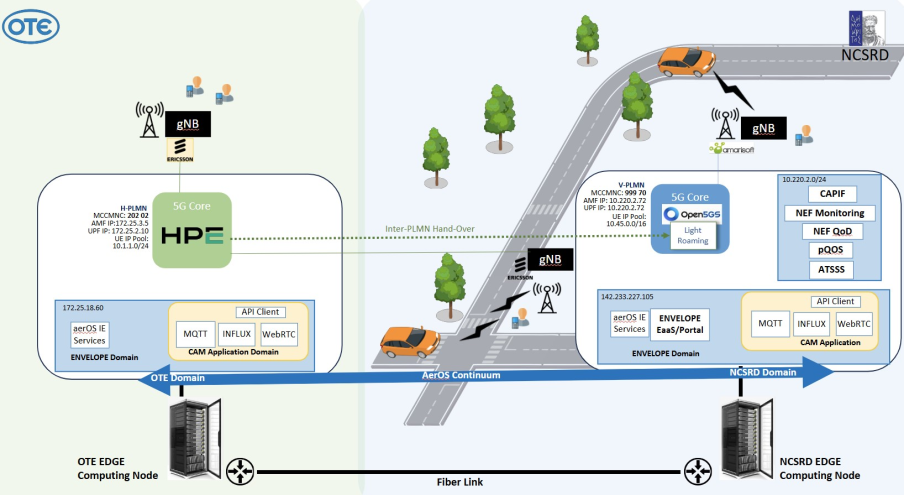
Location: NCSRD-OTE Campus, Athens, Greece.
The Greek site investigates and validates one use-case: MEC handover between multiple Mobile Network Operators (MNOs), demonstrated through a Connected and Automated Mobility (CAM) application for real-time situation awareness. Key innovation items and enablers developed and tested at this site include Predictive QoS (pQoS) as a network-exposed service, ATSSS-like multi-connectivity for dynamic traffic steering across 3GPP and non-3GPP access and dynamic QoS configuration for verticals. The guiding principle of the Greek site is network programmability, exposing network capabilities to applications via its enablers, including the Network Exposure Function (NEF) southbound APIs and the CAMARA-defined northbound APIs, so that vertical services can request information directly from the network.
The site leverages ISFM MILLA’s experience as an autonomous vehicle provider to validate the use case at scale, using the MILLA autonomous shuttle as the end-user vehicle for the trials.
Pilot status (July 2026)
The Greek trial site is fully operational, spanning a federated infrastructure across the OTE and NCSR “Demokritos” (NCSRD) campuses in Athens, interconnected via a dedicated dark-fibre link. Two independent 5G Standalone (SA) networks are live in the n78 (3.5 GHz) band: an Amarisoft radio paired with an Open5GS core at NCSRD (Visited PLMN) and an Ericsson BB6630/Radio 4408 paired with a 5G Core at OTE (Home PLMN). The two networks are configured on adjacent, non-overlapping carriers with synchronized TDD frame patterns to avoid mutual interference. The multi-campus edge-cloud continuum runs on OpenNebula (NCSRD) and Proxmox/Kubernetes (OTE), federated through the aeriOS meta-operating system, forming what the project refers to as the “Athens Testbed Continuum”.
All ENVELOPE network enablers have been deployed and validated at the site: Quality on Demand (QoD), Device Location, Edge Application Management, ATSSS-like multi-connectivity, and Predictive QoS (pQoS), all exposed through CAMARA- and ENVELOPE-defined APIs. A CAM situation-awareness application runs on the vehicle’s on-board unit, providing real-time network metrics, explicit home/visited-PLMN roaming indication, hazard alerts, fully integrated with the QoD, Device Location and pQoS enablers.
Initial trial runs have demonstrated successful inter-PLMN handover between the OTE (home) and NCSRD (visited) networks in almost all test runs, with the optimizations performed at the physical layer providing sufficient performance to support the Greek use case. A framework of six deployed data loggers captures KPIs across the vehicle, core network, edge infrastructure and CAM application layers.
A large-scale trial with the ISFM MILLA autonomous shuttle is planned at the NCSRD premises from September to mid-November 2026, during which the full end-to-end use case will be evaluated.
Partners
NCRSD, ICCS, COSM, FOGUS, ISFM, LUH, ISI/ATH
Use cases
UC 1: MEC handover between multiple PLMNs